What Is the OCD Cycle? The Pattern I Wish I’d Understood Sooner
I was first told I had OCD by a psychotherapist in January 2016. What followed was twenty sessions of CBT, but no one ever showed me a picture of the OCD cycle.
Then I had another round of twenty CBT sessions. Still no cycle.
Later, during my second pregnancy in 2019, I was supported by a perinatal mental health team, and a psychiatrist formally confirmed the diagnosis of OCD. I was very grateful for that care, but still, no one showed me the cycle.
The book that made it click
It was not until 2019, when I still was not much better, that I started reading about OCD for myself. I wanted to understand what was going on and see whether I could help myself.
That was when I came across The Mindfulness Workbook for OCD by Jon Hershfield and Tom Corboy.
The first few chapters completely blew my mind.
I remember feeling so emotional reading them, because suddenly something clicked. The clarity of it made me cry. This was it. This was my problem.
Two things stood out to me in particular: the explanation of fringe thoughts, and the description of the OCD cycle.
What the OCD cycle helped me understand
As soon as I understood the cycle, so much started to make sense.
I understood that intrusive thoughts were not the problem in themselves. I understood why they felt so loaded and urgent. I understood why I was doing compulsions, why the relief never lasted, and why everything kept coming back again.
For me, the cycle looked something like this:
An intrusive thought, image, urge, feeling, or doubt appears
I attach meaning to it
I feel distress, fear, guilt, disgust, anxiety, or uncertainty
I do something to try to feel better, safer, more certain, or more in control
I get temporary relief
Then the thought comes back, and the cycle repeats
That was the lightbulb moment for me.
Seeing my disorder simplified into a basic cycle that could be broken gave me so much fuel to do ERP. There was a process, and it was right there in front of me. It took that huge, tangled mess of intrusive thoughts and reduced it to something manageable.
That mattered so much, because until then it had felt as though I needed a different answer for every thought. But over time I could see that, whatever the theme, the underlying pattern was the same. And that meant the treatment was the same too.
I did not need a separate solution for every intrusive thought. I needed to understand the cycle I was stuck in, and start responding to it differently.
What I was dealing with was not random. It was not proof that I was uniquely broken. It was a pattern. And once I could see that pattern, I finally understood why ERP mattered. I had a reason to do it. A reason to try to break the cycle.
Why I felt angry
And then I felt angry.
Why had no one shown me a version of this on day one? Why had it never been explained to me this clearly?
I felt as though I had been failed.
A clear explanation would not have fixed everything on its own, but it would have helped me understand what I was dealing with much sooner. And that would have meant a lot.
Why I created my version of the OCD Cycle
I knew very quickly that I wanted to create something that could give other people what those chapters had just given me.
Something simple. Something visual. Something that could be printed, handed to someone in therapy, and understood within seconds.
Something that could create that lightbulb moment of, oh, this is what has been happening.
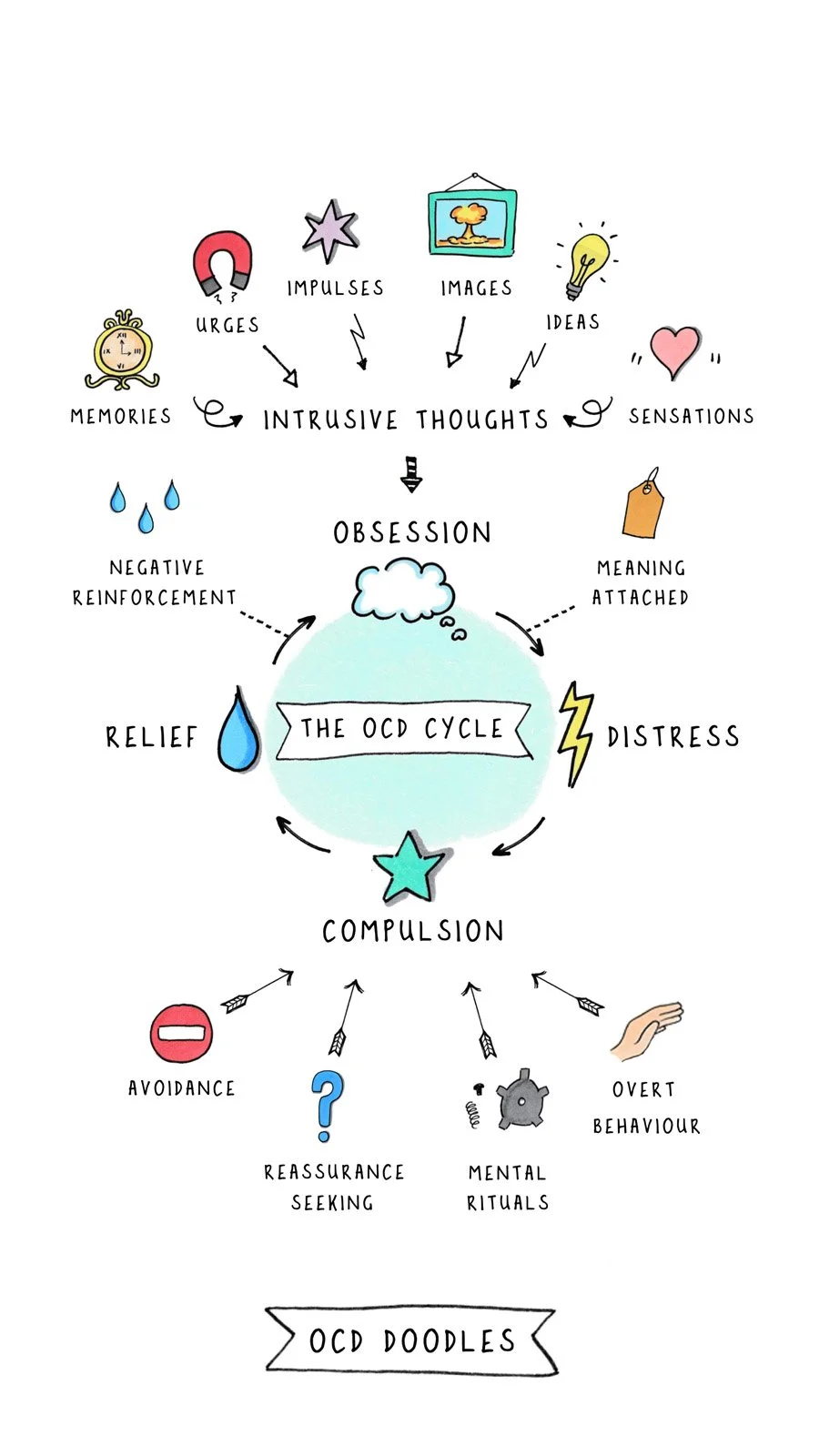
The OCD cycle
This is the visual I created after finally understanding the pattern I had been stuck in for years. It helped me see that intrusive thoughts were not the whole problem on their own. The cycle around them was what kept pulling me back in.
That is why I created my version of the OCD Cycle. Not as therapy, and not as a replacement for proper support, but as the kind of visual explanation I so desperately wish I had been given sooner.
The resource that helped me
If you would like to read the workbook that first helped this click for me, it was The Mindfulness Workbook for OCD by Jon Hershfield and Tom Corboy.
Please note: this is an Amazon affiliate link, so I may receive a small commission if you choose to buy through it, at no extra cost to you.
Explore the OCD Cycle
If the OCD Cycle feels like a useful place to start, there are a few different ways to access it depending on how you’d like to use it.
For personal use, whether for your own understanding or to reflect on alongside a loved one or therapist:
Explore the Personal Use Licence
For qualified therapists wanting to use it in their own 1:1 client work:
Explore the Single Practitioner Licence
If you’d like this visual alongside other core OCD resources, it’s also included in the Starter Collection:
For personal use:
View the Starter Collection – Personal Use
For qualified therapists:
View the Starter Collection – Single Practitioner
If you’re a therapist looking for access to the wider visual resource library, you can also:
Learn more about membership
If you’d prefer something you don’t have to print yourself, I also have this doodle available on a range of physical products like stickers, mugs, and posters here.