From Chaos to Clarity: Why I Created the Compulsions Wheel
I had zero clue that I was doing compulsions.
In my head, compulsions were obvious, physical and repetitive. Checking. Tapping. Ordering. Cleaning. Symmetry. The OCD stereotype.
That was the picture I had. And because I couldn’t see myself clearly in that picture, I missed my compulsions for over two decades. Even once I had a diagnosis of OCD, I wasn’t really taught the definition of a compulsion, or the range of ways compulsions can show up. So I kept missing many of the behaviours that were continuing to feed my OCD.
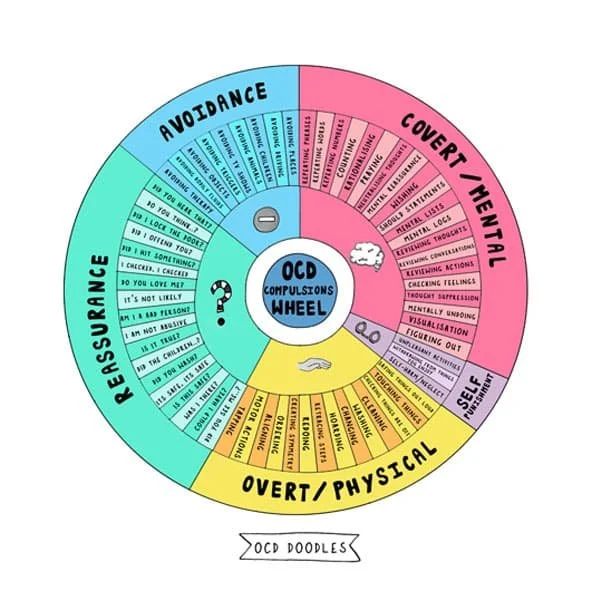
The Compulsions Wheel
The Compulsions Wheel is a visual map of different ways compulsions can show up in OCD, including the quieter and less visible ones I didn’t recognise in myself for a long time.
What I needed, but didn’t have
Looking back, I needed a much wider view.
My compulsions often looked like avoiding people, places, or conversations. They showed up as going over thoughts again and again, subtly asking for reassurance, mentally checking, reviewing, replaying, trying to undo thoughts, or turning things back on myself.
But I didn’t have a way of seeing those things as compulsions, so I didn’t try to resist them. They continued to take up a huge amount of my life.
The time I couldn’t see
I was losing time to behaviours I couldn’t recognise: hours of rumination, quiet avoidance shaping decisions, and loops of mental checking while the world around me carried on regardless.
These behaviours felt second nature. They didn’t stand out to me as disordered. And because I didn’t recognise them, I couldn’t articulate what was happening in therapy. That meant those compulsions weren’t really addressed until around five years after diagnosis, when I finally had the language for them.
The tip of the iceberg
Even in early therapy, once I was diagnosed, I remember things being very focused: one thought, one compulsion, one moment.
And that can matter. But for me, it sometimes felt like we were looking at the tip of something much bigger. Outside of that one moment, there was a whole network of responses I didn’t yet have language for.
I think I needed to see the whole of it. Not perfectly mapped out, but visible enough to recognise. I also needed that bigger picture so I didn’t feel overwhelmed by the sheer number of individual exposures I thought I would have to do. I couldn’t imagine there being enough time in the world to tackle every single thought and behaviour as its own separate problem.
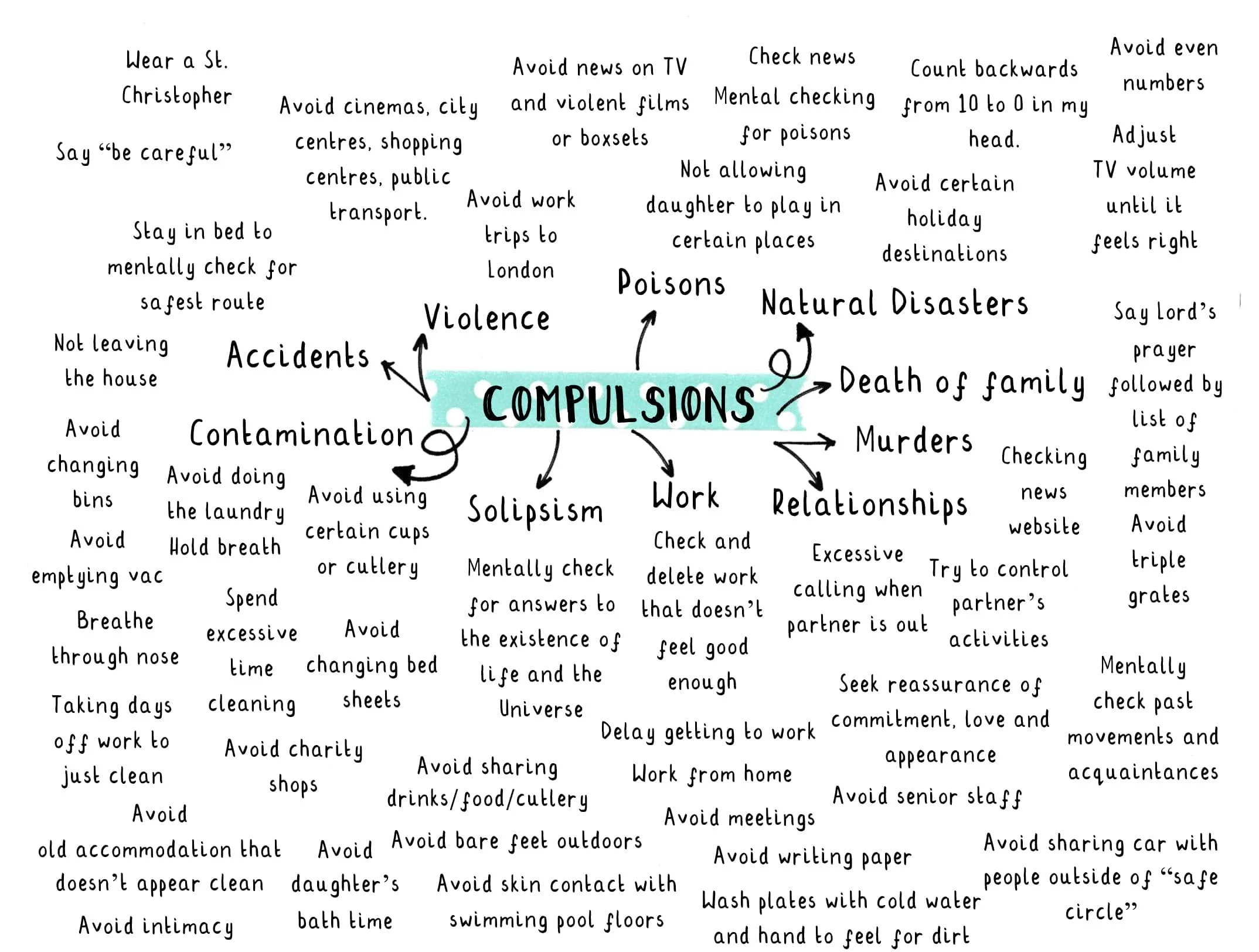
Trying to Map my Compulsions
Two years after diagnosis, I tried to map out many of the behaviours I was doing in response to intrusive thoughts. Seeing them all together felt completely overwhelming, and even then, it still felt like the tip of the iceberg.
Why I created the compulsions wheel
I created the compulsions wheel because I needed to see more than isolated thoughts and behaviours. I needed to see the pattern underneath them.
There were three things I think would have helped me.
The first was to recognise the range of compulsions.
The overt compulsions, yes, but also the quieter ones. The internal ones. The ones that don’t look like anything from the outside. Avoidance, reassurance seeking, mental loops, figuring out, self-punishment. Without that fuller picture, it was easy to miss how much space OCD was taking up.
The second was to see the patterns beneath individual behaviours.
Not leaving the house, avoiding soft play, avoiding charity shops, holding my breath when I felt the air was contaminated, or not calling a friend all felt like separate problems.
Seeing them individually felt overwhelming. But grouping them as avoidance made it feel more understandable. It gave me a clearer place to start. Instead of trying to tackle everything one by one, I could begin to recognise the pattern underneath.
The third was to notice where my time was going.
To be able to step back and think, “Oh… I spend a lot of time here,” or “I avoid more than I realised.”
And then to ask a question that wasn’t obvious to me at the time:
Is this something I’m doing in response to an intrusive thought?
What I hope it offers
My hope is that this wheel gives people a way to see more of the picture at once. Not to diagnose themselves or get everything perfectly categorised, but to have language for behaviours that might otherwise stay hidden.
And if someone takes it into therapy, I hope it can help make the conversation clearer. Not by replacing clinical support, but by making it easier to point to things and say, “this is where I seem to spend a lot of time.”
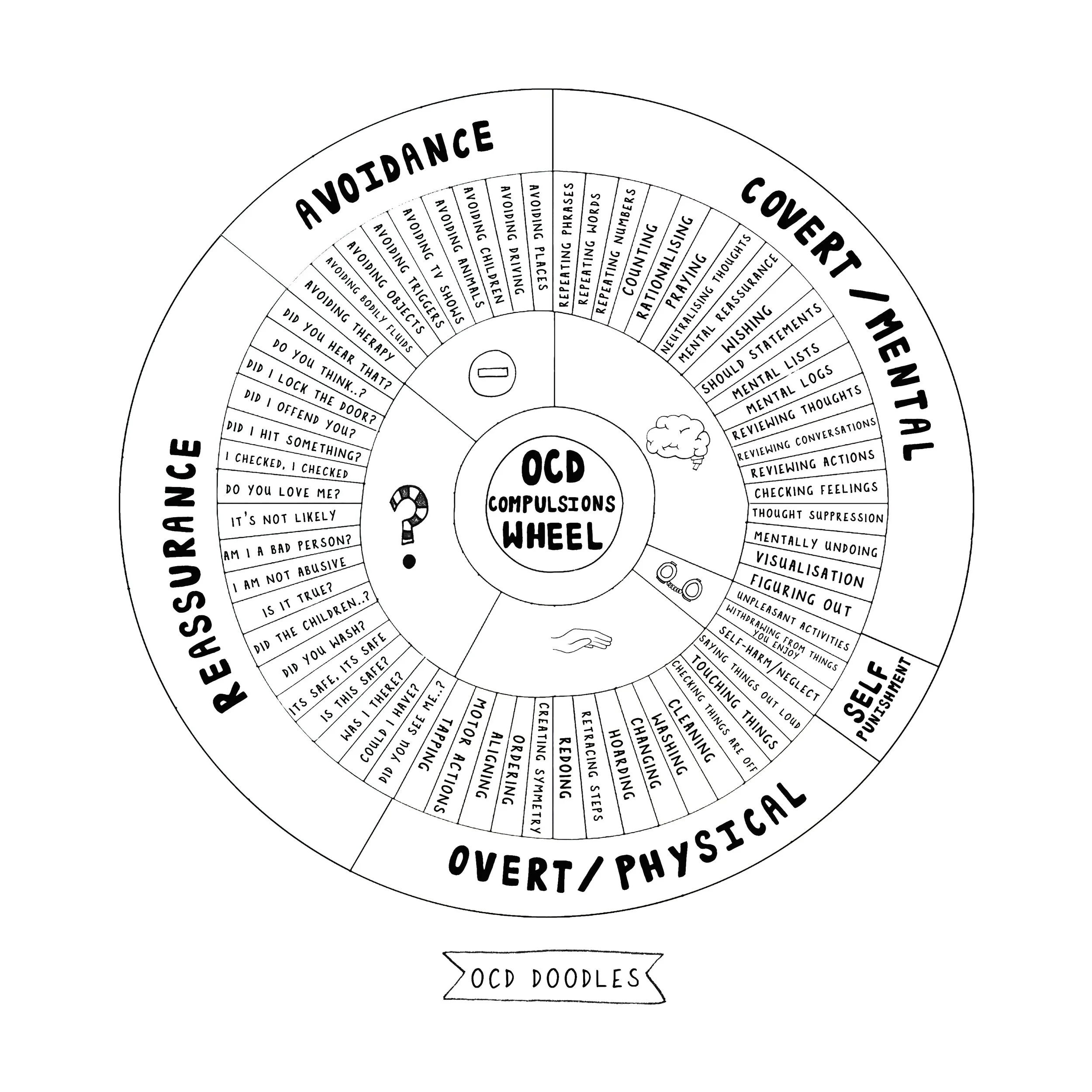
An interactive version
The black and white version is intentional because I wanted it to feel interactive, not just decorative. It can be coloured in, highlighted, annotated, taken away, and reflected on over time.
If I’d seen this earlier
I don’t think it would have changed everything overnight. But I do think I would have recognised myself sooner.
I think my OCD would have been understood and supported better, sooner. And that matters, because I wouldn’t have lost so much time to behaviours I didn’t recognise as part of the problem.
You can’t identify a compulsion if you’ve never been shown what counts as one. And if you don’t know what counts as one, you can’t see how much time and effort you’re giving to it.
Explore the Compulsions Wheel
If the Compulsions Wheel feels like a useful place to start, there are a few different ways to access it depending on how you’d like to use it.
For personal use - whether for your own understanding or to reflect on alongside a loved one or therapist:
Explore the Personal Use Licence
For qualified therapists wanting to use it in their own 1:1 client work:
Explore the Single Practitioner Licence
If you’d like this visual alongside other core OCD resources, it’s also included in the Starter Collection:
For personal use:
View the Starter Collection – Personal Use
For qualified therapists:
View the Starter Collection – Single Practitioner
If you’re a therapist looking for access to the wider visual resource library, you can also:
Learn more about membership
If you’d prefer something you don’t have to print yourself, I also have this doodle available on a small range of physical products like posters, mugs, and cards here.