From Chaos to Clarity: Why I Created the Obsessions Wheel
When I first heard the word obsession in therapy, I did not think of OCD.
I thought of something people said casually, like being obsessed with an album. Or, on the darker side, something deliberate and sinister. The sort of thing you might see in a horror film, where someone is staring at photos of their “obsession” developing under a red light.
I had no idea an obsession could be unwanted, intrusive, and deeply distressing.
So when I started noticing what I now understand were obsessions, recurring intrusive thoughts and other internal information, I did not recognise them at all.
They were not enjoyable. I did not want them. They were not things I was choosing to think about, even though OCD had a way of making me doubt that too.
What obsessions felt like for me
What I was dealing with was recurring internal information that would not leave me alone.
Intrusive thoughts, images, flashes, urges, ideas, sensations, memories. Sometimes just a feeling that something was not right.
They often did not make logical sense, but they felt important. It felt dangerous and irresponsible to dismiss them. They showed up uninvited and demanded my attention, pulling me away from the things that actually mattered and taking up hours of my time.
What overwhelmed me most was not just the content of the thoughts, but the sheer number and variety of them. Every time I thought I had neutralised one, another one appeared. Then another. Then five more.
When I first learnt about intrusive thoughts, it did not neatly simplify things for me. In some ways, it made me realise just how many I was dealing with. Everything felt separate. Everything felt urgent. I could not see any overall shape to it, and I had no idea where to start.
When I tried to map it all out
At one point, not long after I was diagnosed, I tried to write down all of my intrusive thoughts.
I think I hoped that if I could just get everything out in front of me, something would click. Instead, what I ended up with was an overwhelming mess.
When I looked at it, nothing felt clearer. I had managed to capture the chaos, but that was all. I was still just as overwhelmed and confused, and I remember feeling deeply hopeless, wondering how many years of therapy it would take to overcome all of this. I just felt as though I was drowning in details.
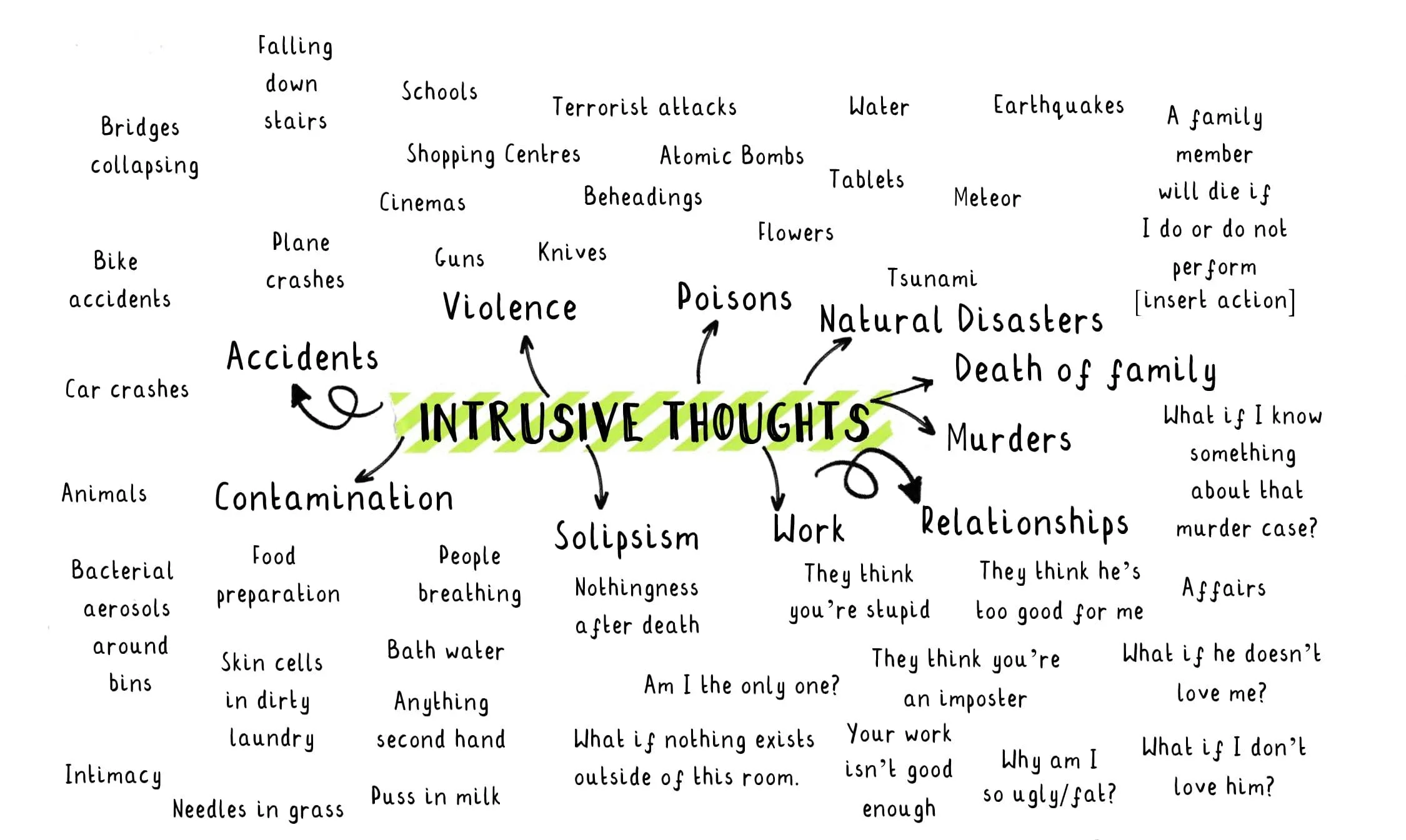
This is the map I created in 2018, two years after I was diagnosed with OCD but before I had specialist OCD treatment. At the time, it still felt too complicated to make sense of. Looking back, I can now see that harm and contamination were my main themes, but I didn’t know that back then.
What would have helped me sooner
I did not need a perfect sorting system, although my OCD probably wanted one! What I needed was a way to step back and understand the bigger picture. I needed to be able to see that not every intrusive thought was a separate problem, and that many of them were connected.
I think that would have helped me articulate what was actually going on, instead of feeling as though I had to remember and untangle every thought individually before I could even begin meaningful treatment.
It would also have helped give direction to therapy much earlier. I wasted so much time trying to sort through everything, thought by thought. If I had been able to recognise my main obsession themes earlier, I think I would have felt less overwhelmed, less lost, and much clearer about what actually needed attention.
Why recognising themes mattered to me
OCD loved to tell me that I was the only one, that I was irreversibly broken, and that there was no hope. So there is something incredibly powerful about realising that other people not only have intrusive thoughts too, but that they can have the very same themes. It helped me see that this is a thing, that this is something OCD does, and that it is not unique to me.
Yes, OCD sits underneath it all, but there is still something deeply validating about meeting another mother who understands how soul-destroying it is to have horrendously graphic harm thoughts about her own children. Or someone who understands the disgust of breathing the air around something you have deemed contaminated. Or someone with moral scrupulosity who understands that crushing guilt that can come just from having a thought.
When I eventually learnt what my themes were, I felt less shame. I also felt like I finally had some clarity and direction.
Why I created the Obsessions Wheel
That is why I created the Obsessions Wheel.
I did not create it to force every thought into a neat category. That is a trap. I created it to offer something I did not have: a way of making OCD feel more understandable when everything felt tangled and hard to explain.
I wanted something that could help people zoom out and say, these are the themes that keep showing up for me. These are the fears I keep getting pulled into. This is the shape of the problem.
That shift matters, not because everything suddenly becomes simple, but because it can take things from feeling like endless, disconnected chaos to something you can describe, reflect on, and begin to talk about.
I made it as a wheel because I wanted to show the bigger picture at a glance. A visual format like this can make it easier to find language for what you are experiencing and communicate it more clearly.
I am not a therapist, and I am not presenting this as a clinical tool in itself. I created it from lived experience, from thinking about what would have helped me when I felt overwhelmed and was struggling to make sense of what was happening. I hope therapists will use their clinical judgement and use it with people they feel it could be helpful for.
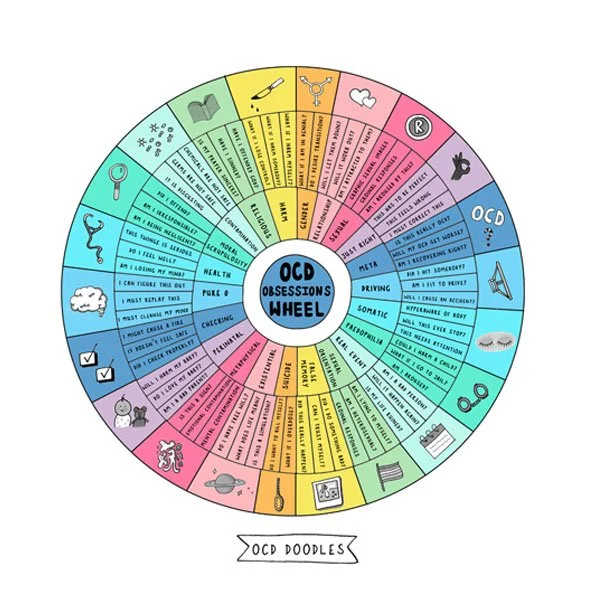
The Obsessions Wheel
This was my way of turning overwhelming chaos into something more recognisable. It’s what I wish I’d seen when I was first diagnosed with OCD.
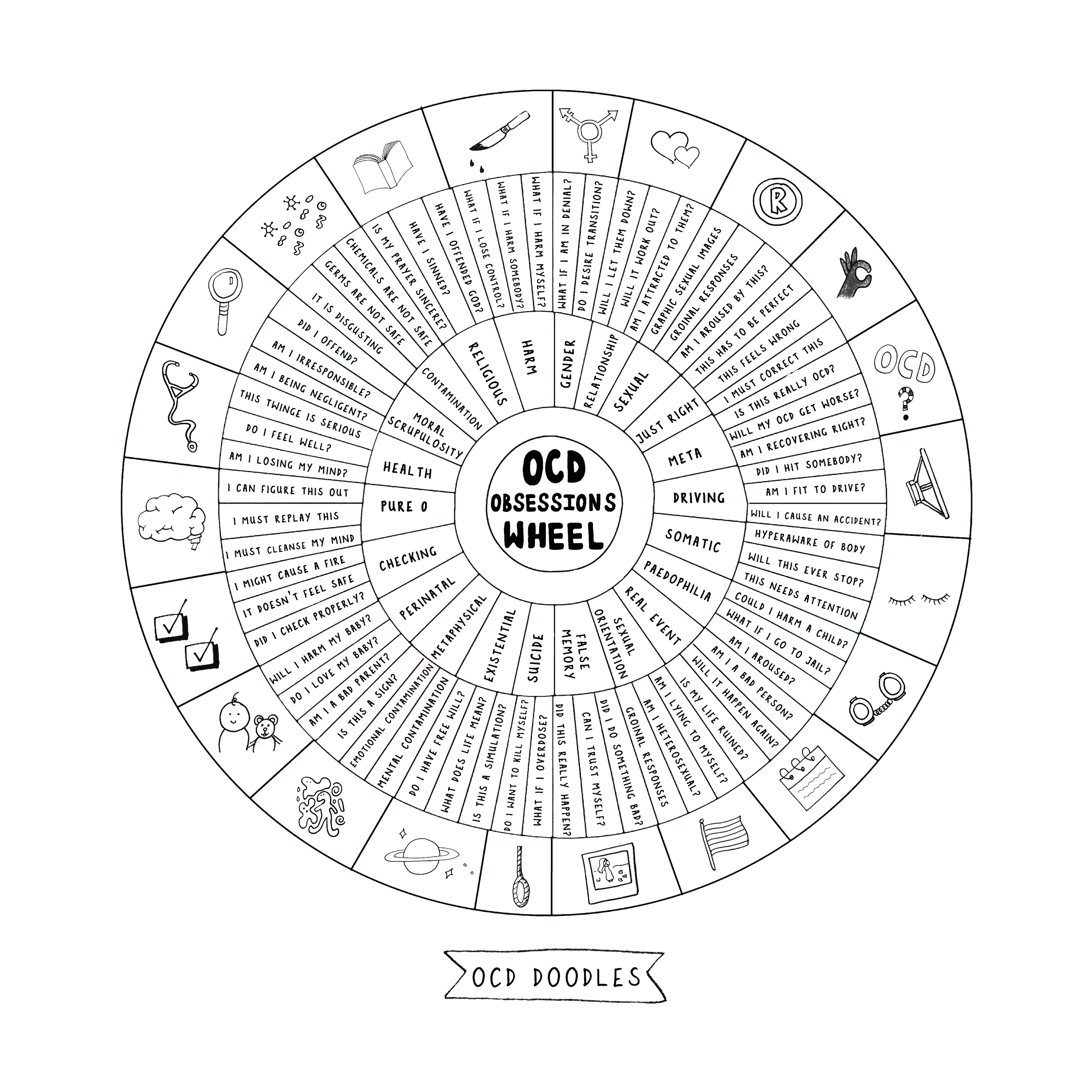
An interactive version
The black and white version is intentional because I wanted it to feel interactive, not just decorative. It can be coloured in, highlighted, annotated, taken away, and reflected on over time.
What I hope it offers
The Obsessions Wheel will not capture every thought perfectly, and it is not meant to. Its purpose is simpler than that. I hope it helps people feel less lost, find language for what they are experiencing, and reach a clearer understanding of their OCD sooner than I did.
I also hope it can be a stepping stone to realising that, while themes can matter for finding your people, feeling less alone, and bringing some direction to the work, there is often a bigger pattern underneath it all: the OCD cycle.
Having that stepping stone would have meant a lot to me back then.
Explore the Obsessions Wheel
If the Obsessions Wheel feels like a useful place to start, there are a few different ways to access it depending on how you’d like to use it.
For personal use — whether for your own understanding or to reflect on alongside a loved one or therapist:
Explore the Personal Use Licence
For qualified therapists wanting to use it in their own 1:1 client work:
Explore the Single Practitioner Licence
If you’d like this visual alongside other core OCD resources, it’s also included in the Starter Collection:
For personal use:
View the Starter Collection – Personal Use
For qualified therapists:
View the Starter Collection – Single Practitioner
If you’re a therapist looking for access to the wider visual resource library, you can also:
Learn more about membership
If you’d prefer something you don’t have to print yourself, I also have this doodle available on a small range of physical products like posters, mugs, and cards here.